


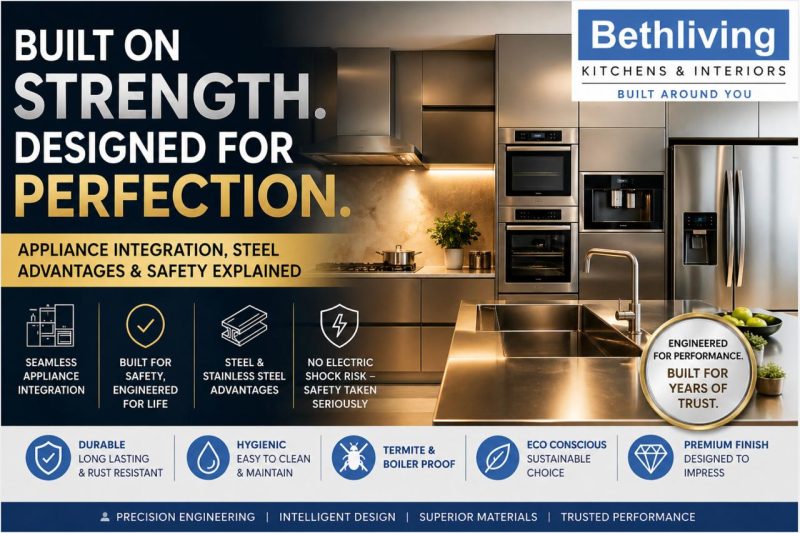
Modern kitchens are no longer defined merely by cabinets, shutters, or decorative finishes. They are now highly functional environments where furniture, appliances, utilities, hygiene, ergonomics, aesthetics, and durability must work together in complete harmony. A truly premium kitchen is not judged only by how impressive it appears on day one—it is judged by how intelligently it performs over the years.
At Bethliving, we believe a kitchen should be engineered with the same discipline used in high-performance products. That means designing cabinetry, built-in appliances, materials, ventilation, electrical systems, plumbing access, and installation methodology as one coordinated system rather than as unrelated components assembled at site.
This integrated philosophy creates a kitchen that looks refined, installs efficiently, functions reliably, and ages gracefully.
Why Appliance Integration Has Become Essential
Today’s premium homes increasingly incorporate built-in appliances such as ovens, microwaves, refrigerators, dishwashers, hobs, chimneys, water systems, and specialty cooling units. These are precision-manufactured products that perform best when installed into cabinetry that has been equally well planned.
When appliance integration is left to on-site improvisation, common issues often arise: inconsistent gaps, awkward filler panels, poor ventilation, inaccessible service points, misaligned elevations, unnecessary cutting at site, and compromised aesthetics.
By contrast, a properly engineered kitchen treats appliances as part of the architecture from the very beginning.
The Strategic Advantage of Factory Integration
One of the most important advantages of a premium kitchen is factory-level integration of built-in appliances. Instead of forcing installers to adapt cabinetry after arrival, Bethliving plans cabinetry around exact appliance specifications in advance and prepares the system under controlled manufacturing conditions
| Performance Area | Conventional Site Integration | Factory Integration by Bethliving |
| Dimensional Accuracy | Depends on manual site adjustment | Precision manufacturing based on actual appliance specifications |
| Installation Speed | Slower due to cutting and fitting | Faster due to pre-planned components |
| Site Cleanliness | Dust, noise, rework common | Cleaner and more controlled installation |
| Aesthetic Finish | Variable gaps and fillers possible | Consistent reveals and premium alignment |
| Error Risk | Higher due to improvisation | Lower due to pre-engineered systems |
| Utility Coordination | Often reactive | Planned in advance |
| Serviceability | Sometimes difficult later | Designed access pathways |
This shift from site improvisation to factory precision is one of the clearest markers of a premium kitchen brand.
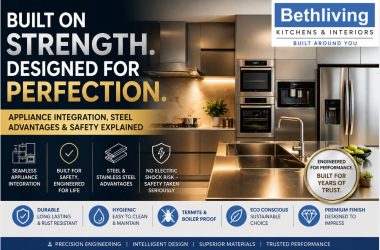
Why Steel and Stainless Steel Are Increasingly Preferred
Kitchen environments face daily exposure to steam, humidity, spills, cleaning agents, repeated movement, heat, and heavy usage. For this reason, material selection has become a strategic decision rather than a decorative one.
Steel and stainless steel provide meaningful advantages in such demanding environments.
| Material Benefit | Why It Matters in Kitchens |
| Structural Strength | Supports heavy appliances and countertops confidently |
| Moisture Resistance | Helps avoid swelling associated with many conventional substrates |
| Termite Immunity | Metal structures are not vulnerable to termite damage |
| Hygiene | Stainless steel is non-porous and easier to maintain |
| Dimensional Stability | Retains alignment over time when engineered correctly |
| Longevity | Designed for demanding daily use |
| Fire Performance | Metal does not behave like combustible wood-based materials |
For clients who value long-term ownership quality, these benefits are substantial.
Addressing the Question of Electrical Safety in Metal Cabinetry
Many customers naturally ask whether metal cabinetry presents any risk of electric shock. In reality, safety depends not on the presence of metal, but on the quality of engineering and electrical installation.
Nearly every modern kitchen already contains metal-bodied products such as refrigerators, ovens, microwaves, dishwashers, chimneys, mixers, and other appliances. These are used safely across millions of homes because they rely on proper earthing, certified wiring, insulation systems, circuit protection, and professional installation standards.
Bethliving follows the same disciplined approach when integrating metal kitchen systems.
| Safety Measure | Purpose |
| Proper Earthing | Safely channels fault current |
| Certified Wiring | Ensures reliable load handling |
| Insulated Routing | Prevents accidental contact |
| Circuit Protection Devices | Reduces electrical risk |
| Wet Zone Separation | Protects utility areas |
| Professional Installation | Ensures standards are followed |
Metal itself is not the hazard. Poor workmanship is the hazard.
Why Bethliving Takes a Different Approach
Many kitchens are sold primarily on appearance. At Bethliving, we believe lasting value comes from combining aesthetics with engineering integrity.
That means every project is approached with deeper technical intent: appliance-first planning, structural suitability, factory precision, service access, alignment discipline, and installation efficiency.
The result is not simply a modular kitchen. It is a professionally integrated living system.
The Bethliving Difference
A premium kitchen should never depend on last-minute improvisation at the customer’s home. It should arrive intelligently planned, accurately manufactured, and ready for refined installation.
Bethliving creates kitchens where appliances, materials, utilities, and design are integrated from the start—delivering superior precision, stronger long-term performance, and a more sophisticated ownership experience.
Frequently Asked Questions
| Question | Answer |
| Why is factory integration better than site fitting? | Factory integration delivers greater precision, faster installation, cleaner execution, and fewer errors. |
| Does Bethliving plan around actual appliance models? | Yes. Bethliving designs using real appliance specifications rather than rough assumptions. |
| Can integrated appliances be serviced later? | Yes. Proper service access is part of responsible engineering. |
| Why choose steel or stainless steel kitchens? | They offer durability, hygiene, strength, moisture resistance, and long-term value. |
| Will a steel kitchen look industrial? | No. Premium finishes and facades allow elegant residential aesthetics. |
| Are metal kitchens noisy? | Not when properly engineered with quality hardware and structured construction. |
| Is electrical safety a concern? | Correctly installed systems with earthing and certified electrical work are safe, just like household appliances. |
| Does Bethliving coordinate plumbing and electrical planning? | Yes. Utilities are integrated into the overall design process. |
| Why do some kitchens feel more premium than others? | Hidden factors such as alignment, integration quality, materials, and execution precision create that difference. |
| Does factory preparation reduce site disruption? | Yes. It significantly reduces cutting, dust, noise, and installation uncertainty. |
| Is this better for long-term ownership? | Yes. Better engineering generally means fewer issues and better durability over time. |