

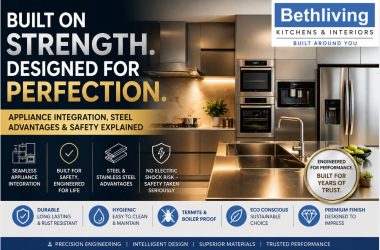

The Steel Truth: 7 Questions Every Homeowner Asks Before Choosing Interiors
"Before you sign a single quotation, read this. These are the 7 questions every smart Indian homeowner is searching for — and the honest answers."
What is the best material for modular kitchen cabinets in India?
Walk into any modular kitchen showroom in Bangalore and you will be shown plywood, MDF, HDF, or marine-grade boards — all dressed up with laminates and called “premium.” For decades, this was the default. But the honest answer to this question has quietly shifted.
In India’s climate — with its humidity swings, monsoon moisture, and urban kitchens that deal with daily steam, oil, and heat — Grade 304 stainless steel is emerging as the most durable cabinet material available. It does not swell. It does not crack. It does not absorb moisture or harbour mould. It is the same material used in hospital operation theatres and professional restaurant kitchens — for exactly these reasons.
At Bethliving.com, every cabinet, wardrobe, and modular unit is built from Grade 304 stainless steel — the global gold standard for food-safe, long-life surfaces. No wood. No PUF. No compromise.
The best material is not the most marketed one. It is the one that performs silently for 20 years without needing repainting, re-laminating, or replacement. In Indian conditions, that material is steel.
Is stainless steel better than wood for home interiors?
This is the big question, and it deserves a direct comparison rather than a vague “it depends.” Let us look at the real-world performance of each:
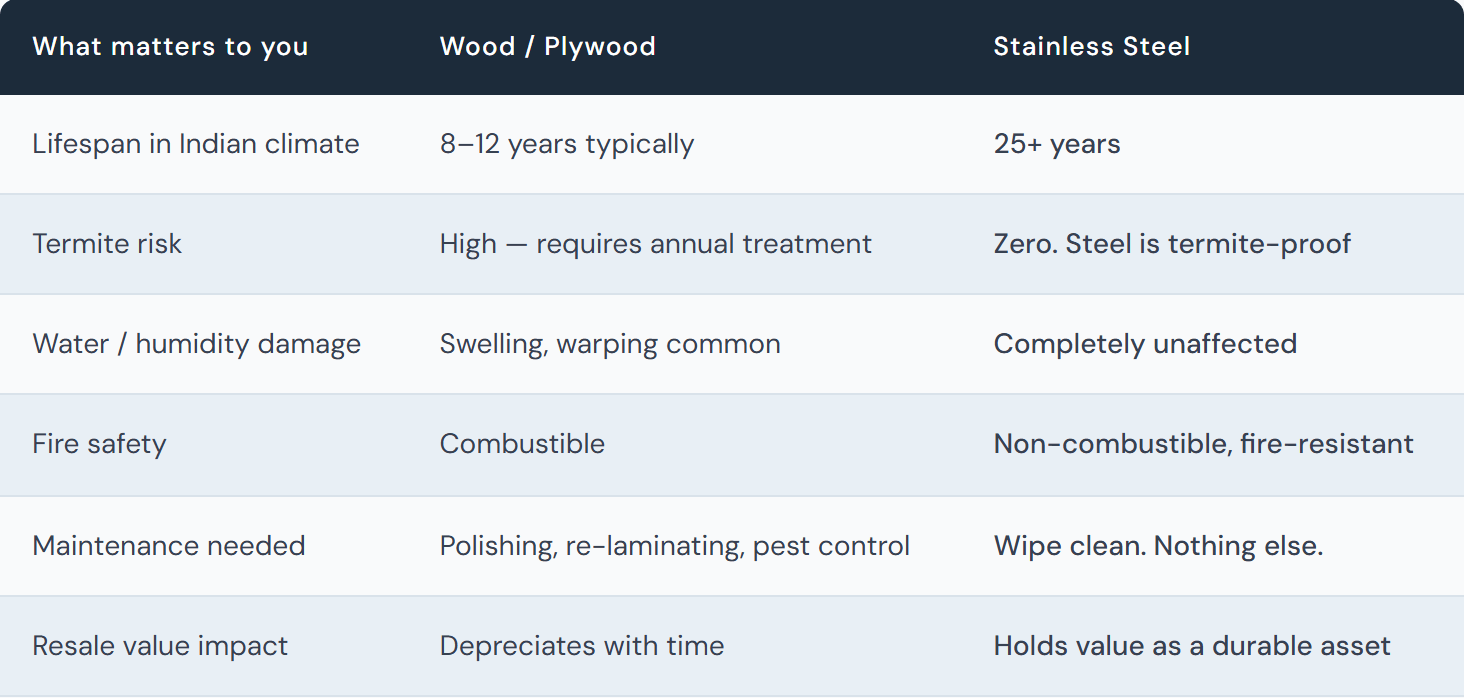
For most Indian homes, the choice of wood is driven by habit and showroom aesthetics, not performance. Once homeowners see the comparison clearly, stainless steel wins on nearly every practical metric that matters for a 20-year home investment.
Bethliving was built on this exact insight — that Indian homes deserve interior materials that actually survive Indian conditions.
What are modular home interiors actually made of?
Most people assume “modular” means a specific material. It does not. Modular simply means the design is pre-fabricated in standard modules — units that are assembled at your home. The material inside those modules varies enormously, and this is where homeowners are most often misled.
Here is what most modular interior companies use:
- Plywood or HDF board (sometimes labelled “marine grade” or “BWR grade”) as the cabinet carcass
- PUF (Polyurethane Foam) insulation inside panels, which adds fire risk
- Laminates or PVC foil as the visible surface finish
- Aluminium or steel only for handles and some hardware
The result looks good on installation day. What happens over 5–10 years in any Indian kitchen — with its steam, humidity, and temperature swings — is a different story.
Bethliving's philosophy is called Zero Wood, Zero PUF. Every structural component — carcass, shutters, shelves, drawers — is Grade 304 stainless steel. The finish is clean, precise, and built to outlast the home itself.
Which material lasts longest for kitchen and wardrobe?
Longevity in home interiors is determined by how a material responds to three enemies: moisture, pests, and time.
Solid wood, when properly dried and treated, can last decades — but it is expensive, requires maintenance, expands and contracts with humidity, and is still vulnerable to termites unless chemically treated. Plywood and MDF — which power 90% of India’s modular interior market — are significantly less durable. They are compressed wood fibres. When moisture gets in, they degrade from the inside out, often invisibly.
Grade 304 stainless steel, by contrast, is used in marine environments, food processing plants, and surgical equipment. It is, without question, the longest-lasting material available for home interiors. It does not rust in normal indoor conditions, does not attract pests, and does not degrade with age.
If you are building a home you intend to live in for the next 20–30 years — or a home you want to pass on — stainless steel is the only material that genuinely matches that time horizon. Bethliving designs every project with this lifespan in mind.
Problems with wooden modular kitchens in humid climates
If you live anywhere in India with a pronounced monsoon season, you have probably already encountered this. The kitchen that looked pristine in January starts showing its true character by August.
Here is what actually happens to wood-based modular kitchens in India’s humid seasons:
- Cabinet doors begin to warp at the edges, making them difficult to close flush
- The carcass, typically plywood, absorbs ambient moisture and swells — causing drawers to stick or jam
- Laminate begins peeling at joints, especially near the sink and hob area
- Dark patches form inside base cabinets where ventilation is low — early-stage mould
- Termites find their way in through the back panels, which are the thinnest part of any modular unit
"Humidity does not announce itself. It quietly destroys — one swollen drawer, one peeling laminate, one hidden termite colony at a time."
None of these problems exist with stainless steel. Steel does not absorb moisture. It does not swell. Termites cannot eat it. Mould cannot take hold on a properly finished steel surface. These are not marketing claims — they are material properties.
Bethliving’s customers across India report zero humidity-related issues across years of use. That is not luck. That is the right material choice.
What is zero wood interior design?
Zero wood interior design is exactly what it sounds like: a complete home interior — kitchens, wardrobes, storage units, vanities — built without using any wood or wood-derived material in its structural components.
This is not a design style or a visual aesthetic. It is a material philosophy. The driving idea is that wood, in all its forms, is a liability in modern Indian homes — a material chosen by tradition and supply chain convenience, not by performance.
Zero wood design typically uses one of two alternatives: aluminium-framed units with glass or acrylic panels, or — at the premium performance end — Grade 304 stainless steel for the full structure.
Bethliving pioneered the Zero Wood, Zero PUF philosophy for Indian homes. Every unit leaves the factory with zero wood in the carcass, zero PUF in the panels, and zero compromises on material quality. The result is an interior that is safer, cleaner, and built to last a lifetime.
Zero wood also has environmental logic. Wood-based panels — plywood, MDF, particleboard — use formaldehyde-based resins that off-gas over time inside your home. Steel emits nothing. For families with young children or respiratory sensitivities, this distinction matters.
It is a concept that sounds radical until you understand why. Then it becomes obvious.
Are steel modular kitchens fire safe?
This is perhaps the most important question on this list, and it is the one most brands hope you will not ask about their own products.
Here is the honest answer about common modular kitchen materials and fire safety:
- Plywood and MDF are combustible — they catch fire and contribute to flame spread in a kitchen fire
- PUF (Polyurethane Foam), used as insulation inside many modular panels, is highly flammable and releases toxic fumes when it burns
- Some laminates also add to the fire load inside a kitchen
The kitchen is the highest fire-risk room in any home. It contains open flames or high-heat appliances, cooking oils, and enclosed cabinet spaces. What your cabinets are made of matters enormously in the event of a kitchen fire.
Stainless steel does not burn. It does not contribute to fire spread. It does not release toxic gases. In the event of a kitchen fire, steel cabinets act as a passive barrier — not as fuel.
This is why commercial kitchens, hospital kitchens, and food factory environments have been 100% steel for decades. The safety logic is not new. Bethliving simply brings it home — literally.
When you choose Bethliving’s Zero Wood, Zero PUF interiors, you are not just making an aesthetic decision. You are making your home measurably safer for everyone who lives in it.
Ready to See What Steel Interiors Look Like in a Real Home?
Explore our home tours, get a cost estimate, or book a free design consultation with Bethliving's team.
Visit Bethliving.com bethliving.com